
Pianism
...and the realization of Piano Forte

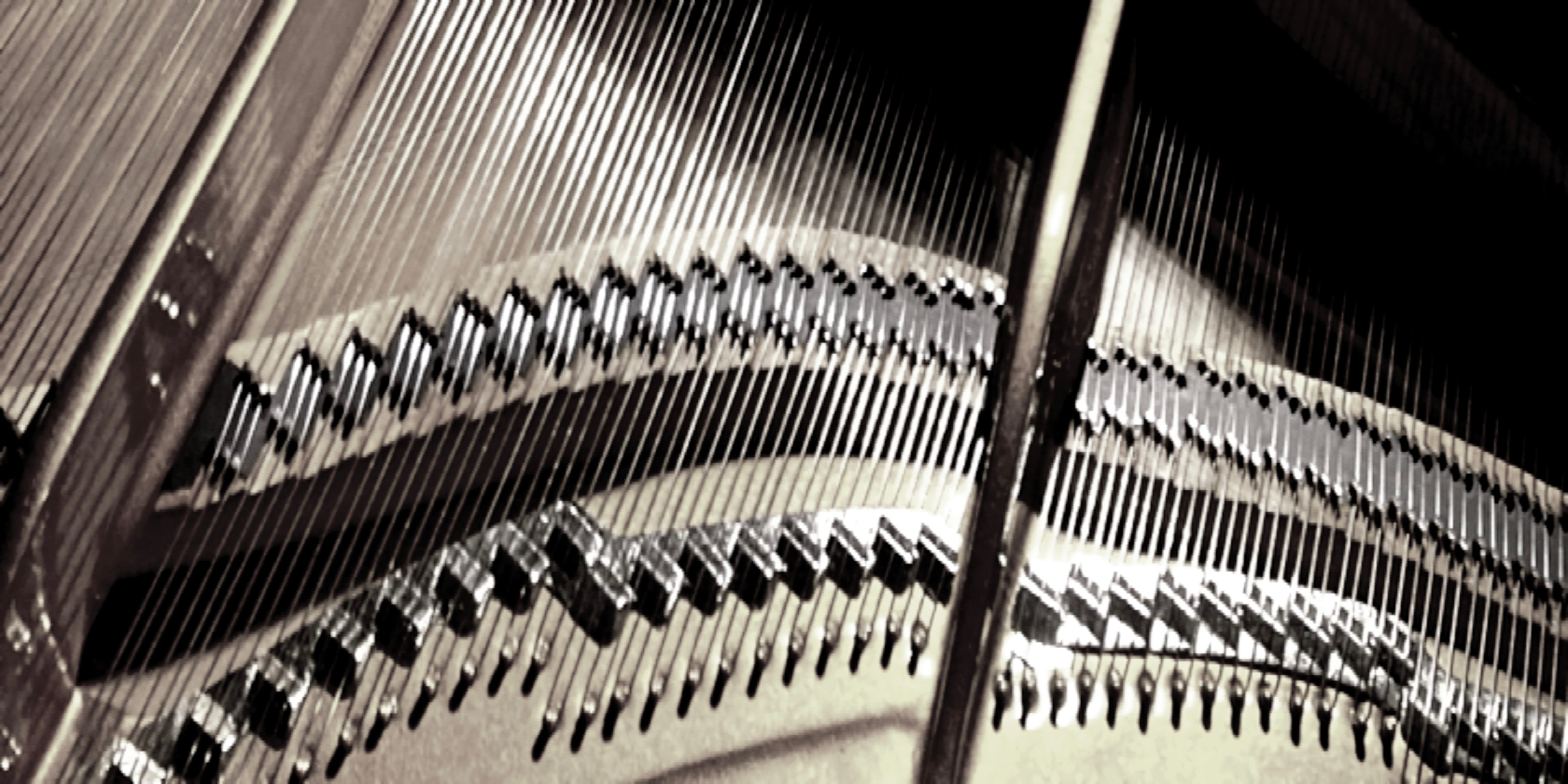
Piano guts - photo by E#
I confess, I’m not a pianist, just a composer with intermittent access to a piano. Way back in the last century, 1958 to be exact, I was much more of a pianist though probably not much of a musician. By the tender age of 7, I’d developed some chops which were on display when, as part of a recital by the piano students of Joan Mayer, I played my first gig ever performing Liszt Hungarian Rhapsody Nr. 2 at Carnegie Recital Hall in NYC. I loved the music and the sound of the piano, but I found the lessons and practice discipline quite oppressive. I developed asthma in an attack that nearly killed me a few days after the recital. A hospital stay led to a few weeks absence from school but stuck at home in an oxygen tent. I was no longer a pianist! When I entered 4th grade the following year I began to play clarinet - I liked the sound and it was good for my lungs.
Finding my way back to the piano in 1985 was chronicled in detail in my book IrRational Music and in the notes to the album K!L!A!V! This latter record included my performance on piano of the composition Mapping, more sonic than pianistic and a precursor to the set of pieces that I’m releasing as Piano Forte. A guiding principle for me on guitar was that it was six oscillators and a resonator. The piano expands the number of oscillators and the sophistication of the resonator. As a student, Henry Cowell, Bela Bartok, John Cage, Thelonious Monk, Cecil Taylor, and Charlemagne Palestine all revealed exciting pathways with which to approach the piano.
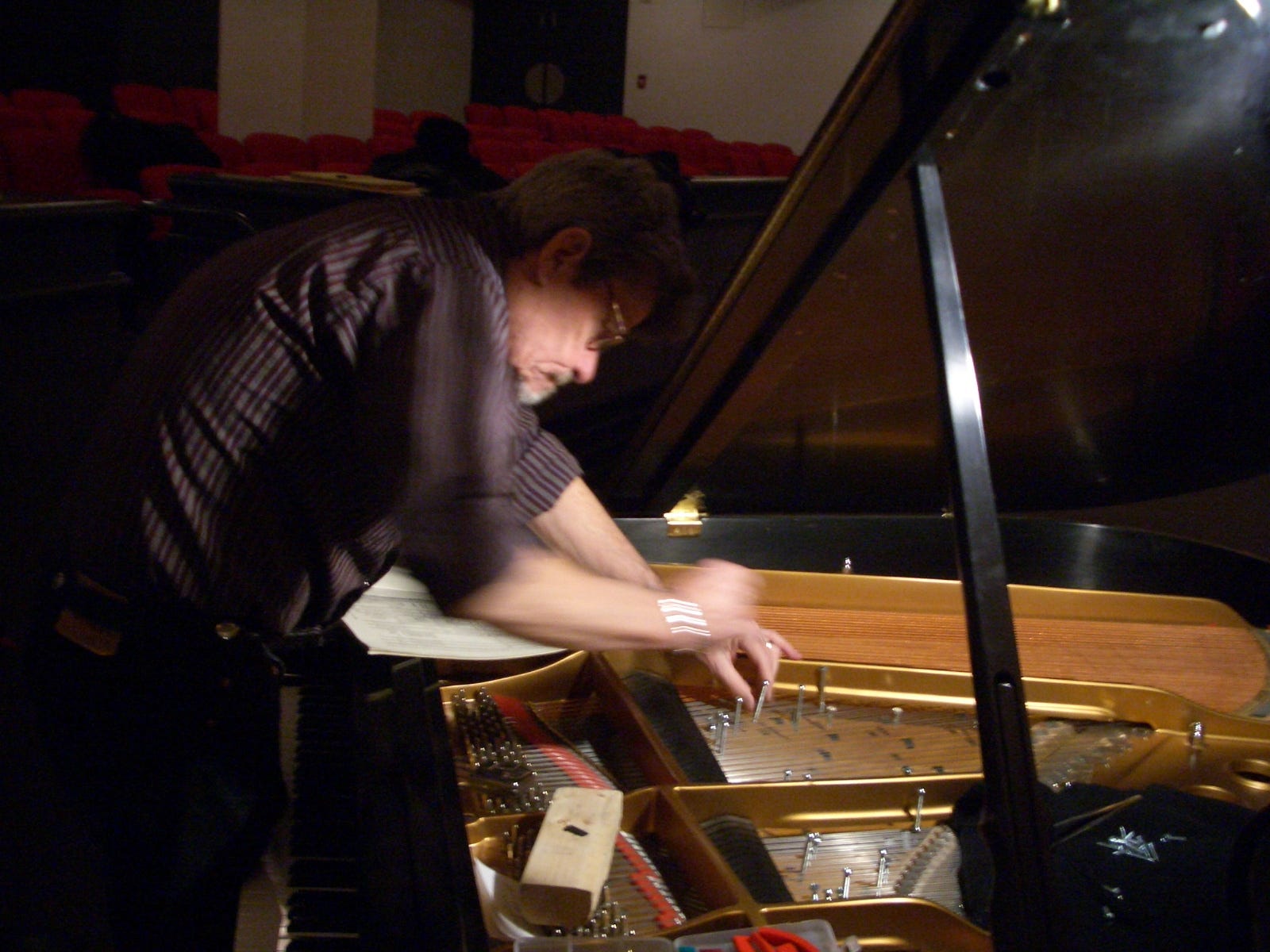
James Tenney “preparing” the piano for a performance of John Cage’s Sonatas and Interludes for Prepared Piano, MOMA - NYC, January 2005 - photo by E#
The piano played an important role in my compositions for orchestra Calling in 2002 and On Corlear’s Hook in 2006 as well as the solo piece Oligosono, written in 2004 for the virtuoso Jenny Lin, with a language based on genetics, physics, and the acoustics of resonance. These same elements were also at play in such compositions as Tessalation Row, SyndaKit, and Quarks Swim Free. All make use of modules ranging from one to multiple bars in length that may be looped and recombined in a bio-morphological approach but also allowing spontaneous disruptions, mutation, and extrapolations. Extended techniques in Oligosono include an overtone sweep created by sliding the index finger (or in the case of clusters, multiple fingers) pressed on the strings as a shifting mute while striking the keys for the chosen strings with the other hand to produce a cascade of harmonics. Another technique was having the pianist play the notes directly on the strings near the keyboard with the sustain pedal down. On which strings this would be played was dependent on the construction of the piano soundboard and where there exists a gap between support struts. Finally, there may be repetitive ostinati with sustain pedal and played using alternating fingers on two hands thereby producing a saturated array of overtones, a sound not manifested by playing the given riff with two fingers on one hand.
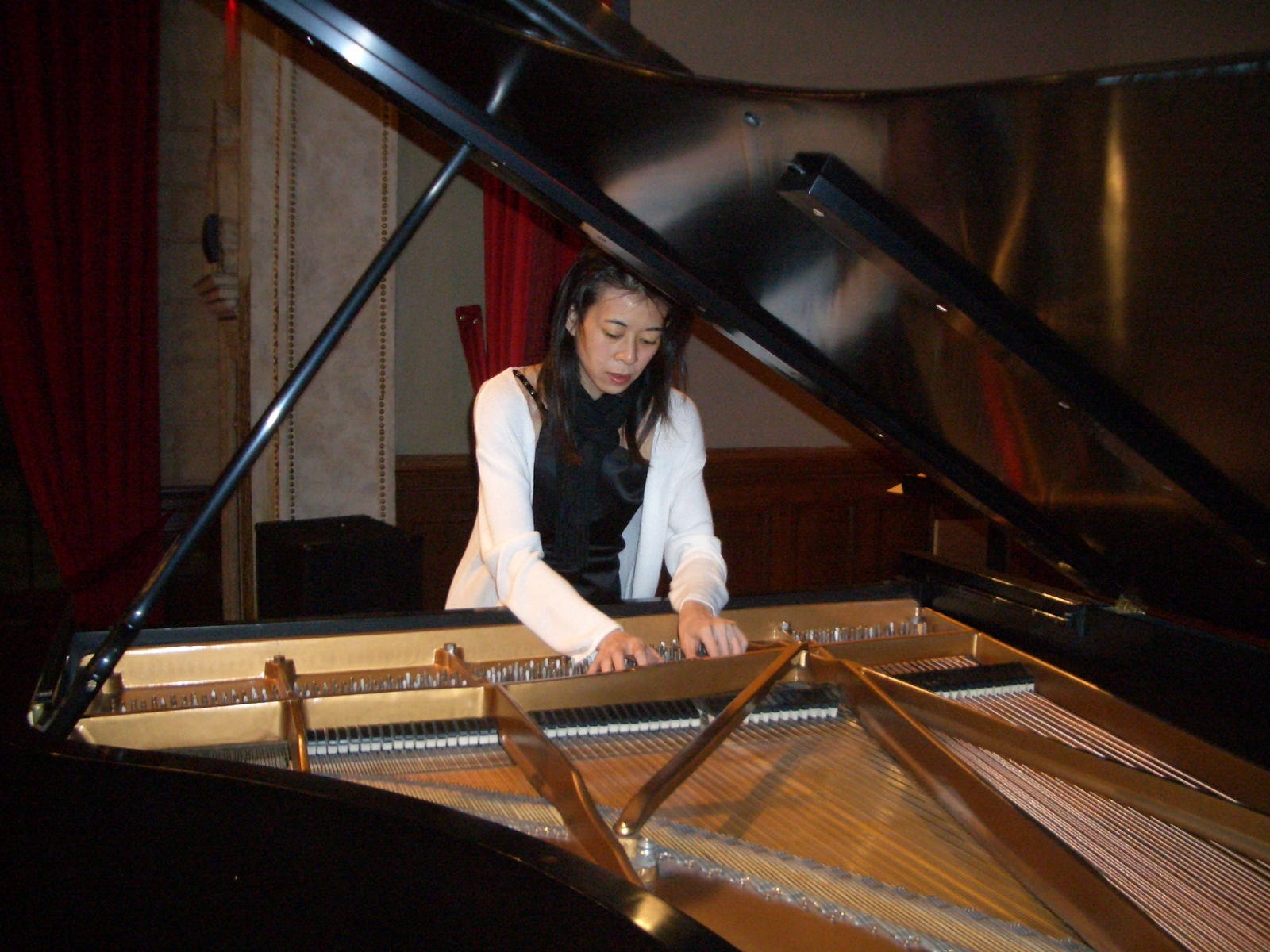
Jenny Lin performing the premiere of Oligosono, Italian Academy, NYC - Dec. 2004 - photo by E#
My friends Alanna Heiss and Fred Sherman were traveling and in their absence, I was offered the use of their wonderful Steinway B piano. This generosity created the substrate on which a set of new pieces, Piano Forte, were realized inspired by the poetics of physics and the tactility of sound.
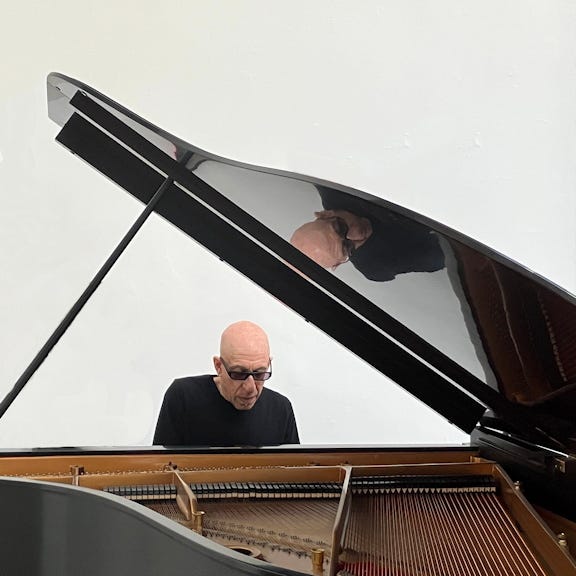
E# on piano - photo by Helene Breschand
Besides techniques used in previous piano works, one that informs much of Piano Forte involves fingering a cluster in the middle register, playing the same notes one octave lower with a sforzando attack and then immediately pressing the sustain pedal to reveal a set of floating harmonics reinforced by the sympathetic vibration of the notes that are being held down. The title of the collection, Piano Forte, of course refers to the measures of soft and loud but also a nod to the predecessor of the modern piano, un cimbalo di cipresso di piano e forte invented in the late 18th century by Bartolomeo Cristofori of Padua, a noted builder of harpsichords. Later shortened to pianoforte and finally piano, this revolutionary instrument allowed control of volume and attack with pedals as well as an unparalleled range of pitch.
Piano Forte and will be released on zOaR Bandcamp on May 1.
https://elliottsharp1.bandcamp.com/
Congrats on the upcoming release!